
Publications / Portraits & commissions
Corporate headshots in Toronto: what to settle before shoot day
By Capt. Solomon D. Crowe
· 8 minute read
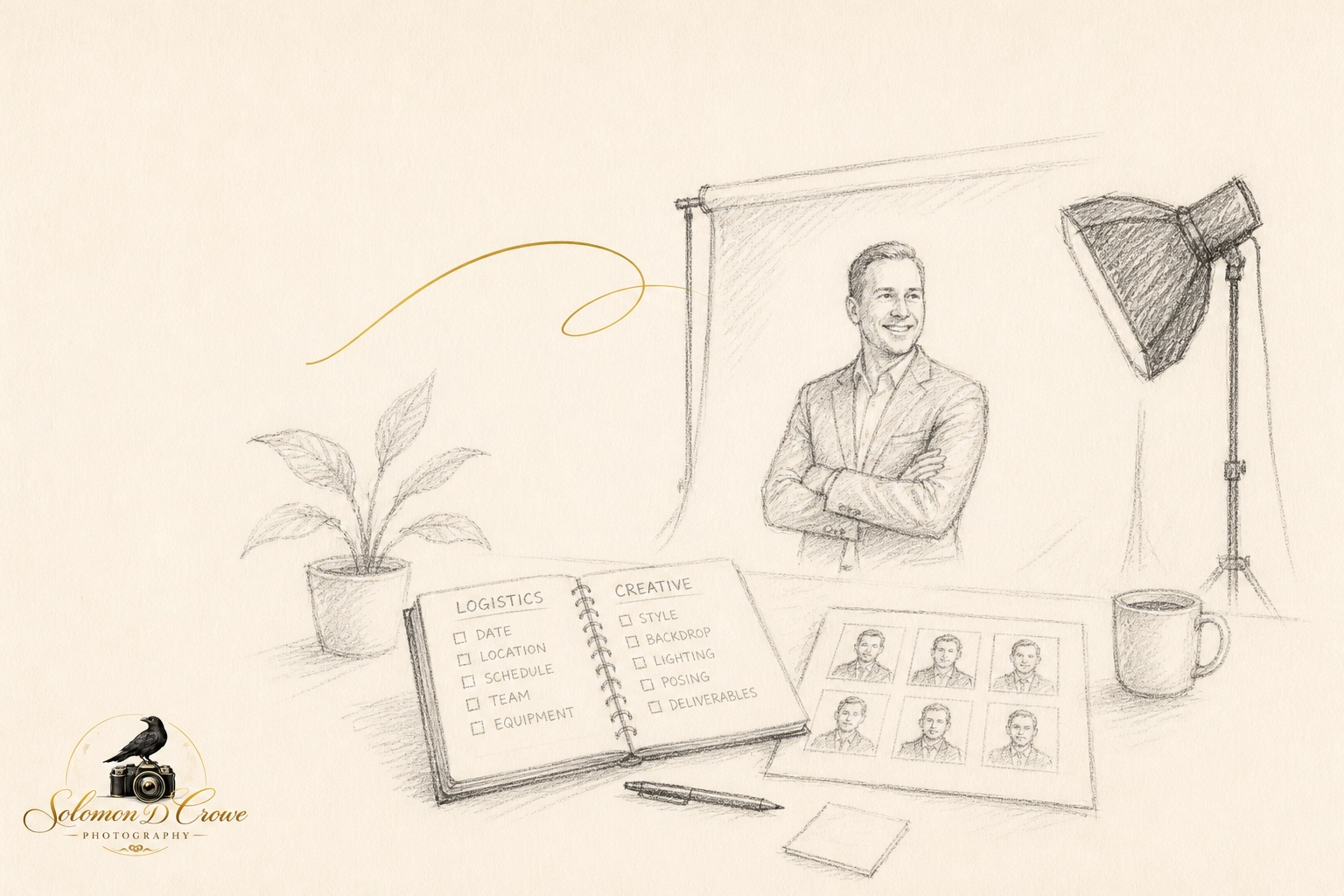
Booking a corporate headshot photographer in Toronto is the easy part. The hard part lands in the week before: someone has to decide how the portraits will be lit, which wall or room they'll be taken against, what people should wear, how long each person gets, and who signs off — and often nobody has written any of it down.
This post works through those decisions in the order they come up, from the shot list and the background to the clothing brief and the final approval. The argument is straightforward: a headshot day is settled the week before, not on the morning of. A team lead who works through those choices with the photographer, and puts them in writing, gets portraits that match how their people are actually seen.
Decide where the portraits will work before anyone stands in front of the lens
The planning behind corporate headshots in Toronto starts with a list, not a camera. Over the next couple of years a face will appear on the team page, on LinkedIn, on proposal covers, on conference banners, in recruitment ads and in press requests. Each of those crops the same file differently and shows it to a different audience, and a portrait composed for one may not suit the others.
Turn that list into a shot list
Three frames cover most of it: head-and-shoulders for the team page, a slightly wider frame for proposals and press, and one consistent set so nobody looks as though they were photographed on a different day. Write the list per person, not per company.
Choose the reference crop
A square thumbnail, a tall profile frame and a wide banner cut the same portrait three ways. Decide which crop the composition is built for — usually the one seen most often — and let the other two follow from how the sitter sits inside it.
Settle delivery with your web and brand teams
Agree the file types, sizes, naming convention and the usage you need permission for before the shoot, rather than in an email three weeks after it.
Answer the LinkedIn question where it belongs
"Can we use the same photo on LinkedIn?" Put the answer on the shot list, beside each person's name, instead of leaving every sitter to guess.
Studio, boardroom, or a wall you already own
Settle the location on logistics before anything aesthetic. Four questions decide it: how many people are being photographed, how far each of them would have to travel, whether the room leaves space for a light stand and a tripod without rearranging the furniture, and whether a queue of colleagues outside the door keeps sittings moving or turns each one into a performance. A steady corridor usually helps — people arrive warmed up and leave on time. A glass-walled room the whole floor can see into usually does not.
| Your office | Studio | |
|---|---|---|
| Travel | None | Everyone travels |
| Variables | Ceiling height, mixed daylight, a boardroom booked over you | Fixed and controllable |
| Feel | This is where we work | This is who we are |
On-site saves a team the trip and hands you the room's problems. A studio removes those problems and puts the cost on travel — and in downtown Toronto, traffic is part of that cost.
Then pick a background tone that survives your website palette and the re-brand after it. A mid-tone that separates hair and shoulders from the wall is far more forgiving than pure white or pure black, both of which leave much less room for a tight crop.
Decide the surface too. Seamless paper, a textured wall, or the workplace itself. Seamless travels better across a mixed team; the workplace says something seamless cannot.
Whatever you choose, hold it constant — across this team and the hires after them, so the team page reads as one set of portraits rather than a patchwork assembled over five years. For corporate portrait photography in Toronto, that decision belongs in writing before the first person sits down.
A clothing brief people will actually follow
Send guidance, not a dress code. A short paragraph in plain language plus a colour range does more than a page of rules nobody reads — and it lets people bring themselves to the sitting instead of arriving as a uniform.
Set a range, not a requirement
Choose tones that hold up against the background you picked in section two, then widen the range so it works across different bodies, budgets, cultures and genders. Don't require everyone to own a suit. Don't put the whole team in the same shirt either; matching shirts flatten a group into a logo rather than a set of colleagues.
Name what the camera exaggerates
- Busy patterns and thin stripes
- Large logos
- Stark white
- Dangling jewellery
- Glasses that catch the light or hide the eyes
People can act on a short list of specifics. They can't act on "business casual".
The line that outperforms the rest
Ask everyone to bring a second option and to arrive dressed as they would for a client meeting. That single instruction covers more ground than any detailed list, because it gives people a decision they already know how to make.
Say what you'll have on the day
Ask which facilities are available: a place to change, a mirror, and whether steaming, grooming or makeup support is included or needs arranging.
How long each person actually needs
Don't budget a flat figure per head. Budget the pace of the day. Setup and lighting tests are done before the first appointment, and realistic appointment lengths and buffers are agreed with the photographer in advance. A schedule built on identical slots either overruns at the start or leaves you holding time you didn't need at the end.
Build the running order around who can't leave their desk
Leadership early, before their day fills up. Customer-facing teams in blocks, so a department arrives and leaves together. Then a deliberate buffer — one real gap, not a hopeful five minutes — for the late arrival or the meeting that runs over.
Answer "how many photographs do we get?" before the day
Agree whether the goal is one usable frame per person or a small set of variations. That decision, not the headcount, sets how long each sitting runs: a single frame is a short sit; variations mean more time and more direction from me.
Protect the end of the day
Group and team-together frames are the pictures everyone asks for afterwards, and the first casualty of a tight schedule. Put them last and defend that time.
Book the delivery window in the same conversation
Review, retouch and delivery are part of the schedule, not an afterthought, and the delivery date belongs in the brief. Any questions about your team's booking can go through my contact page.
Who is in the room, and who signs off
Someone on your side has to be able to say "that's the one" — and mean it. Name that person before the day. Otherwise a sitter stands under the lights polling four colleagues on whether the chin is right, and the sitting turns into a meeting with a camera in it. One decision-maker, agreed in advance, keeps each sitting short and each sitter relaxed.
Keep the queue off the set
Being watched produces a camera-face faster than anything else you can do to a person. Give the next sitter a chair, a mirror and a closed door between them and the shoot, and let them be collected when it's their turn. If the room is glass, find another wall.
Bring the person who knows how they want to be seen
A manager, a close colleague, an assistant — someone who knows how this particular person wants to look. Bring them for the two minutes of framing and grooming, then send them back to work. Their job is that two minutes, not the whole sitting.
Settle approvals before anyone stands in front of the lens
Write down three things: whether sitters see their own frames, who has the final word on selects, and what happens if someone dislikes every frame. Decide the resit or alternative-frame policy now, quietly, rather than in front of them.
The one-page brief to send seven days out
Seven days out, send one written pack. Not a thread, not a shared folder of screenshots — a single document people can open on the morning of the shoot and act on.
It contains the date, the location and arrival windows, the shot list, the background you've chosen, the clothing guidance, who will be on set, and the delivery date and formats you expect back.
Confirm the logistics with the photographer separately
This is the part teams forget. If the shoot is on-site, confirm room dimensions and ceiling height, power and parking, load-in time, and who unlocks the door — with a name and a phone number attached. A boardroom that looked generous on a floor plan can be tight once a light stand and a sitter are in it.
Three lines per sitter, no more
Every person in the run of day gets the same three lines:
- What to wear
- When to arrive
- How long their sitting will take, taken from your own running order
Nothing else. Long briefs get skimmed; three lines get followed.
Publish the order and protect the buffer
Send the run of day with names and times to everyone on the list. When a gap appears, leave it. The buffer is what absorbs a delayed train, an overrun or a shirt that needs changing.
After delivery
Check the crops at thumbnail size against your original list of uses — the intranet circle, the conference banner, the byline — before you accept them. Get sign-off from the decision-maker you named in advance, and file the selects where your web and brand teams can actually find them.
If you want to talk through a day for your team, my contact page is the place to start.
© 2026 Capt. Solomon D. Crowe · Solomon Crowe Photography
← All publications · Discuss a commission
Explore the Editorial Journal